Inside the app
A closer look.

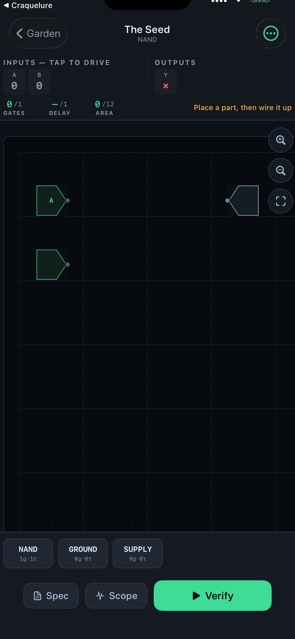

About this app
Made for a clear purpose.
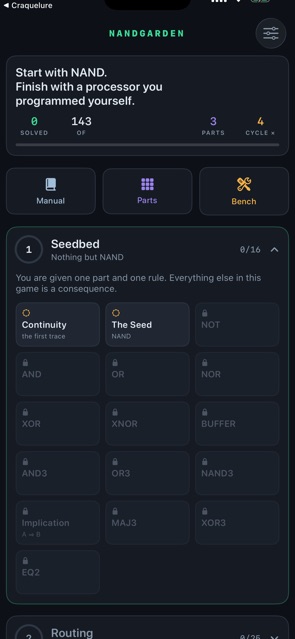
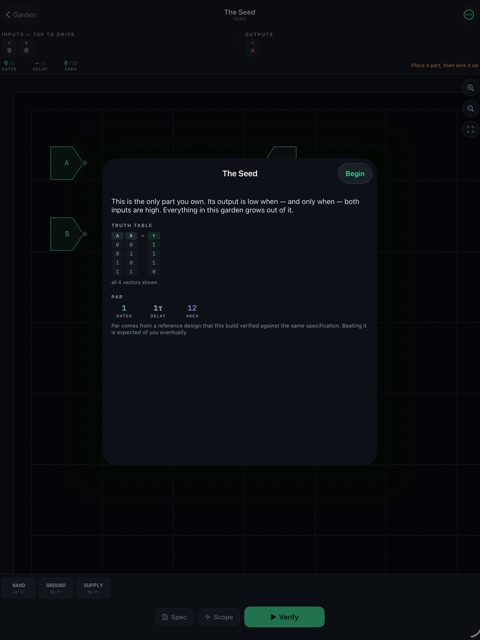
You are given one part: a NAND gate. Its output is low only when both of its inputs are high. Everything else in this game — inverters, multiplexers, adders, memory, an arithmetic logic unit, a working processor — is something you build out of it.
Nandgarden is a 143-puzzle engineering campaign across eight chapters. Drag parts onto a grid, route wires with a finger, and watch signals propagate at real gate delay. Tap any input pin and the board goes live: the wires light up, the outputs settle, and you can see a design working before you ever press Verify.
THE LADDER, ON A PHONE
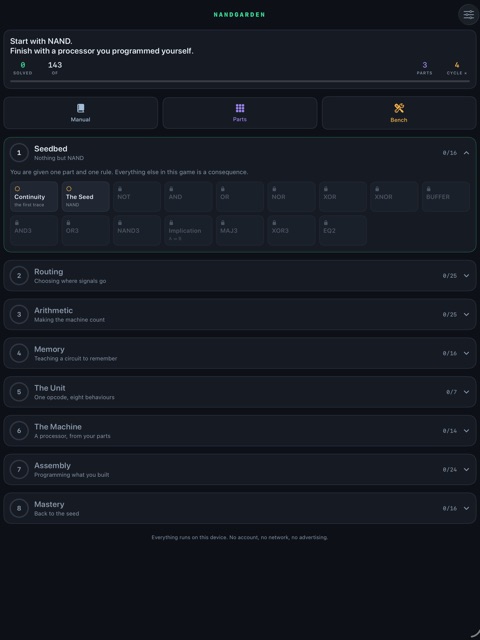
Chapter one gives you nothing but NAND, and you derive NOT, AND, OR, XOR and the rest from it. Chapter two is routing — multiplexers, decoders, encoders, buses. Chapter three is arithmetic, from a half adder to a three-bit multiplier. Chapter four teaches a circuit to remember, starting with two cross-coupled gates and ending with a register file. Chapter five assembles an arithmetic logic unit. Chapter six builds the machine around it. Chapter seven is twenty-four assembly programming puzzles on the processor you just designed. Chapter eight takes every unlocked part away again and asks you to rebuild the classics from raw NAND, under a gate budget.
YOUR PARTS CARRY YOUR NUMBERS
When you solve XOR, XOR becomes a placeable block — priced at whatever your solution actually cost. Build a wasteful adder and every later circuit that uses one inherits the waste. By the assembly chapter, your machine's cycle count is derived from the settling time of the arithmetic logic unit you personally built. Two people can write identical programs and finish in different numbers of cycles.
THREE SCORES, NOT ONE
Every correct circuit is measured three ways, independently: gate count, propagation delay along the critical path, and board area. They genuinely conflict — balanced trees cut delay and cost area, shared terms cut gates and lengthen paths — so there is no single number that captures a good design and this game does not invent one. Each score is placed on a histogram against par, and par comes from a reference design that the build verified against the same specification your circuit is checked against.
WHEN IT FAILS, IT TELLS YOU WHY
Verification runs the complete truth table where it is small enough and a curated set of edge cases and deterministic vectors where it is not. A failing run names the exact input combination that broke, loads it onto your bench, and shows what each output should have been. A scope panel draws the waveforms with the mismatched steps highlighted. Oscillating circuits are reported rather than left to spin.
AN ILLUSTRATED MANUAL
One hundred and fourteen pages, bundled and readable offline: a datasheet for every part with its pinout, truth table, timing waveform and application notes; twenty-six theory pages covering Boolean algebra, De Morgan's laws, Karnaugh maps, fan-out, critical paths, hazards, setup and hold, metastability, two's complement, carry lookahead and instruction-set design; plus reference tables, a gate symbol chart, the full instruction set and a glossary.
ALSO INCLUDED
A free sandbox bench with eight inputs and eight outputs and no specification at all, saved locally. A purist mode built into the final chapter. Reference designs you can inspect after solving. Netlist sharing through the system share sheet.
WHAT IT DOES NOT DO
Nandgarden is a one-time purchase. There is no advertising, no in-app purchase, no subscription, no account and no telemetry. It makes no network connections of any kind and works identically on a plane. Your progress, saved benches and personal bests are stored on your device and go nowhere else.
Everything in the bundle — the artwork, the sound, the music, the manual and all 143 puzzle specifications — was generated by the project's own pipeline. No third-party assets are included.